Primitive Reflexes: Why They Matter for Your Baby’s Development
Disclaimer: Please note this advice is general only and not specific to the needs of your child, unless we have specifically prescribed this care to you and your child. If you have any concerns please seek advice from your local paedicatric health professional.
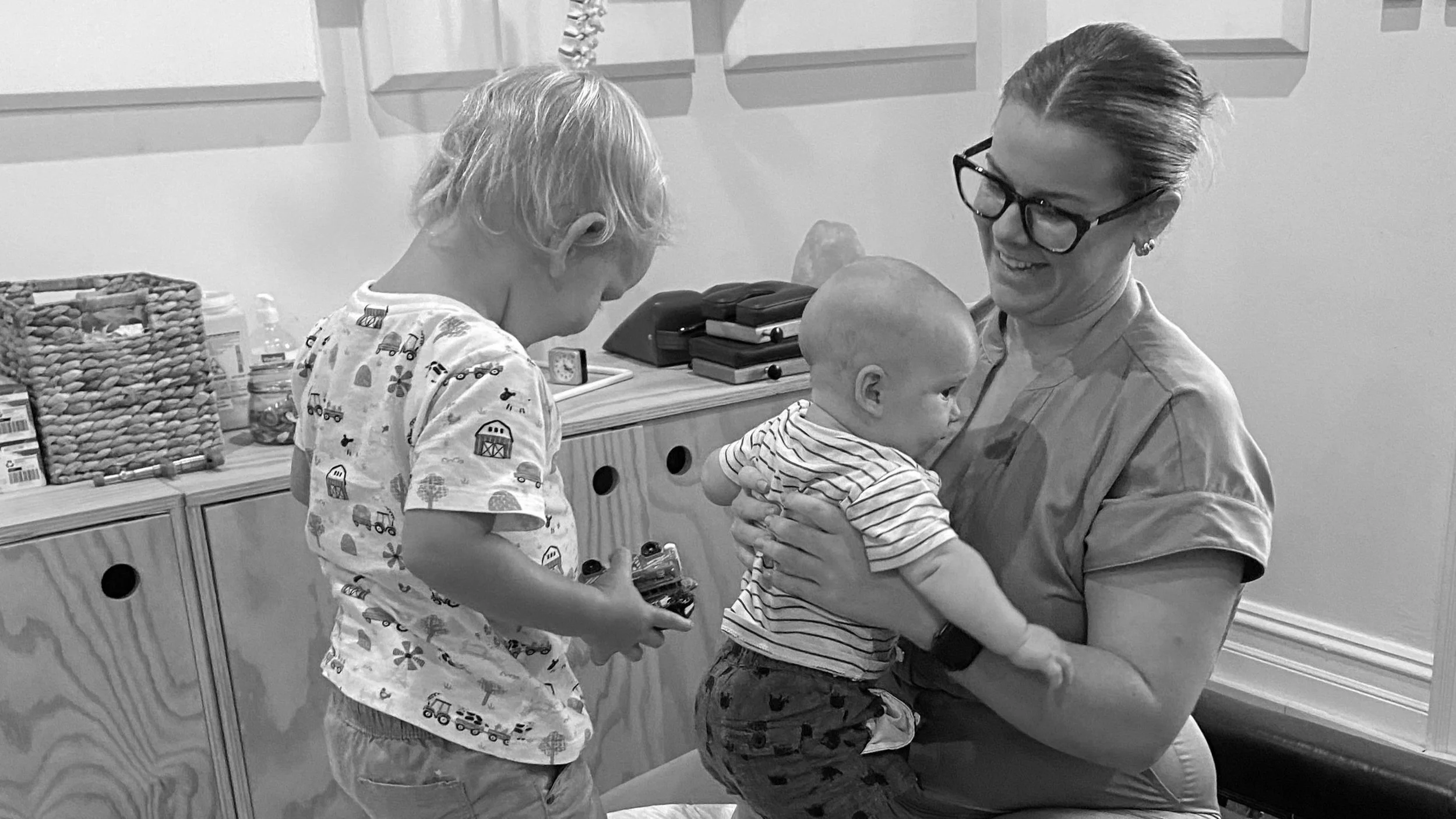
Primitive reflexes are automatic, instinctive movements that every baby is born with. They’re the building blocks of your child’s nervous system—laying the foundation for motor skills, emotional regulation, posture, and sensory awareness.
As your baby’s brain matures, these reflexes should naturally integrate—meaning they quiet down and make way for more controlled, purposeful movements. When a reflex lingers beyond its normal window, it can create roadblocks to milestones like crawling, walking, or even focusing and self-soothing.
Below is a guide to each reflex, why it’s important, what happens if it doesn’t integrate, and simple home-care activities to support your baby’s progress.
Moro Reflex (Startle Reflex)
Description: A sudden noise, light, or movement causes your baby to fling their arms out wide, then draw them back toward their body.
Importance: A protective survival reflex that helps babies cling to their caregivers for safety.
Typical Integration: Around 4–6 months of age.
If Retained, It May Lead To:
Heightened startle response or anxiety
Emotional sensitivity or poor stress tolerance
Sleep disruption or difficulty settling
Poor balance or motion sickness
Sensory overload in noisy or bright environments
Home Care Advice:
Keep a calm, low-stimulation environment.
Practice gentle rocking or rhythmic movement.
Encourage secure attachment through skin-to-skin and predictable routines.
Rooting Reflex
Description: Stroking your baby’s cheek causes them to turn toward the touch and open their mouth to feed.
Importance: Helps your baby locate the breast or bottle for feeding.
Typical Integration: Around 4 months.
If Retained, It May Lead To:
Difficulty transitioning to solid foods
Messy or slow eating
Over-sensitivity around the mouth or face
Speech or articulation issues
Poor awareness of food texture or oral motor control
Home Care Advice:
Encourage breastfeeding or bottle-feeding practice in various positions.
Gently stroke the cheeks before feeding to stimulate rooting awareness.
Include gentle facial massage to desensitize the area.
Sucking Reflex
Description: Automatic sucking when the roof of the mouth is touched.
Importance: Vital for feeding and oral motor development.
Typical Integration: 2–3 months.
If Retained, It May Lead To:
Speech delays or articulation issues
Thumb sucking or teeth grinding
Oral fixation or chewing on objects
Difficulty swallowing or managing saliva
Home Care Advice:
Offer safe chew toys, teething rings, or pacifiers.
Encourage mouthing play (blowing raspberries, gentle vibration toys).
Transition gradually to straw or open-cup drinking to strengthen oral coordination.
Grasp Reflex
Description: When something touches the palm, your baby’s fingers automatically close around it.
Importance: Early bonding and tactile feedback development.
Typical Integration: Around 5–6 months.
If Retained, It May Lead To:
Poor fine motor control or handwriting difficulty
Tension in hands or arms
Difficulty releasing objects voluntarily
Hand fatigue during drawing or writing
Home Care Advice:
Offer toys that promote squeezing, grasping, and letting go.
Practice gentle finger stretches and massage.
Engage in play that alternates open–close hand motions (e.g., clapping games).
Asymmetrical Tonic Neck Reflex (ATNR)
Description: When the baby’s head turns to one side, the arm and leg on that side extend while the opposite limbs flex.
Importance: Supports hand–eye coordination and cross-body development.
Typical Integration: By 6 months.
If Retained, It May Lead To:
Difficulty crossing the midline
Clumsy handwriting or letter reversals
Poor visual tracking or reading difficulties
Postural asymmetry (head tilt or shoulder rotation)
Coordination issues in sports or dance
Home Care Advice:
Encourage tummy time to strengthen neck and shoulder control.
Use colorful toys to encourage head-turning and reaching across the body.
Play “follow the toy” games to integrate head and body coordination.
Symmetrical Tonic Neck Reflex (STNR)
Description: When your baby lifts their head, arms straighten, and legs bend—when the head drops, the opposite happens.
Importance: Key for developing crawling and separating upper from lower body movement.
Emerges: Around 6–9 months, integrates by 12 months.
If Retained, It May Lead To:
Difficulty crawling or skipping the crawl stage
Poor posture or “W” sitting
Tension in neck and shoulders
Difficulty sitting still or concentrating
Poor swimming or coordination skills
Home Care Advice:
Encourage crawling over varied surfaces and obstacles.
Play “peek-a-boo” games that involve looking up and down.
Encourage transitions from crawling to sitting and back again.
Palmar Reflex
Description: Touching the palm causes the baby to close their fingers automatically.
Importance: Early foundation for voluntary hand control.
Typical Integration: 5–6 months.
If Retained, It May Lead To:
Poor fine motor skills or pencil grip
Hand tension and fatigue
Difficulty tying shoelaces or manipulating small objects
Home Care Advice:
Practice finger painting, sensory play with sand or rice.
Encourage picking up small safe objects to improve precision.
Introduce early self-feeding to encourage finger dexterity.
Stepping (Walking) Reflex
Description: When held upright, your baby makes stepping motions with their feet.
Importance: Prepares the legs and brain for future walking patterns.
Typical Integration: Around 2 months.
If Retained, It May Lead To:
Delayed independent walking
Poor balance or coordination
Toe walking or uneven gait patterns
Home Care Advice:
Hold your baby upright on a soft surface to encourage stepping.
Provide supported standing play at low furniture.
Encourage bare feet for sensory feedback and balance.
Palmo-Mental Reflex
Description: Stroking the palm causes the chin muscles to twitch or open the mouth.
Importance: Linked to oral–motor development and sensory processing.
Typical Integration: 3–4 months.
If Retained, It May Lead To:
Sensory sensitivities or oral–motor dysfunction
Dribbling or open-mouth posture
Difficulty with spoon feeding or speech control
Home Care Advice:
Provide safe oral exploration toys.
Incorporate sensory textures in play (sponges, fabrics, water play).
Encourage hand–mouth play like blowing kisses or imitation games.
Plantar Reflex
Description: Stroking the sole causes toes to curl inward.
Importance: Develops sensory awareness and grounding through the feet.
Typical Integration: Around 9–12 months.
If Retained, It May Lead To:
Balance or walking difficulties
Flat feet or tiptoe walking
Trouble with jumping, hopping, or running
Poor posture or coordination
Home Care Advice:
Encourage barefoot play on grass, sand, and textured mats.
Let your baby push off against your hands or surfaces.
Practice standing and cruising along furniture for balance.
Supporting Healthy Integration
Playful, intentional movement is one of the best ways to help your baby’s reflexes integrate naturally. Allow plenty of tummy time, floor play, and free exploration each day.
If your baby skips milestones, seems unusually sensitive, or struggles with coordination, it’s worth having them assessed. At Nomad Chiropractic, we use gentle neurological-based assessments and corrective care to help babies and children integrate their reflexes, balance their nervous system, and thrive through every developmental stage.
Want to learn more? Book a FREE 15min discovery call with one of our Sydney Baby Chiropractors today: Book HERE
-
Melillo, R. (2016). Disconnected Kids: The Groundbreaking Brain Balance Program for Children with Autism, ADHD, Dyslexia, and Other Neurological Disorders. TarcherPerigee.
Goddard Blythe, S. (2005). Reflexes, Learning and Behavior: A Window into the Child’s Mind. Fern Ridge Press.
Williams, S. (2016). Chiropractic Pediatrics: A Clinical Handbook. Churchill Livingstone Elsevier.
Haavik, H., & Murphy, B. (2012). The Role of Spinal Function and Chiropractic Care in Improving Sensorimotor Integration. Journal of Electromyography and Kinesiology, 22(5), 768–776.
https://doi.org/10.1016/j.jelekin.2012.01.005Institute for Functional Neurology (IFN). (2023). Primitive Reflex Integration and Neurological Development in Children.
International Chiropractic Pediatric Association (ICPA). (2022). Neurodevelopmental Milestones and Primitive Reflex Patterns in Infancy. www.icpa4kids.com
Melillo, R., & Leisman, G. (2010). Autism: A Unified Theory of the Neurological Disorder. Springer.
National Institute of Child Health and Human Development (NICHD). (2021). Motor Developmental Milestones. https://www.nichd.nih.gov
Blythe, P., & Goddard Blythe, S. (2011). Developmental Reflexes and the Foundations of Motor Learning. Journal of Educational and Child Psychology, 28(3), 35–43.
Melillo, R., & Carrick, F. R. (2020). Functional Disconnection Syndrome: Functional Neurology and Primitive Reflex Retention. Frontiers in Integrative Neuroscience, 14(33), 1–11.
https://doi.org/10.3389/fnint.2020.00033Australian Spinal Research Foundation. (2022). Primitive Reflex Retention, Postural Control and Chiropractic Care in Paediatric Populations. https://spinalresearch.com.au
Goddard Blythe, S. (2018). Assessing Neuromotor Readiness for Learning: The INPP Developmental Screening Test and School Intervention Programme. Wiley-Blackwell.
Walker, S. P., et al. (2011). Inequality in Early Childhood: Risk and Protective Factors for Early Child Development. The Lancet, 378(9799), 1325–1338.
https://doi.org/10.1016/S0140-6736(11)60555-2
-
This information is for educational purposes only and is not a substitute for professional medical advice. If you have concerns about your child’s development, consult your paediatrician, GP, or a qualified paediatric chiropractor.