
Why Chiropractic Care for Babies Isn’t Just a “Nice to Have” — It’s Foundational Support for the Developing Nervous System
Why Do Babies See Chiropractors?
Babies can experience physical tension and nervous system stress from pregnancy, birth, feeding difficulties, and early developmental challenges. At Nomad Chiropractic in Mosman, we provide gentle, neurologically-focused chiropractic care for babies to support feeding, digestion, sleep, movement, posture, tongue function, and nervous system regulation.
Our approach combines cranial chiropractic care, Sacro Occipital Technique (SOT), reflex assessment, and collaborative care with IBCLC lactation consultants, paediatric dentists, midwives, and other health professionals. We commonly support babies experiencing reflux, unsettled sleep, latch difficulties, tongue tie-related tension, torticollis, flat spots, and feeding challenges.
We also believe pregnancy chiropractic care, the Webster Technique, and postpartum support play an important role in creating healthier outcomes for both mothers and babies.
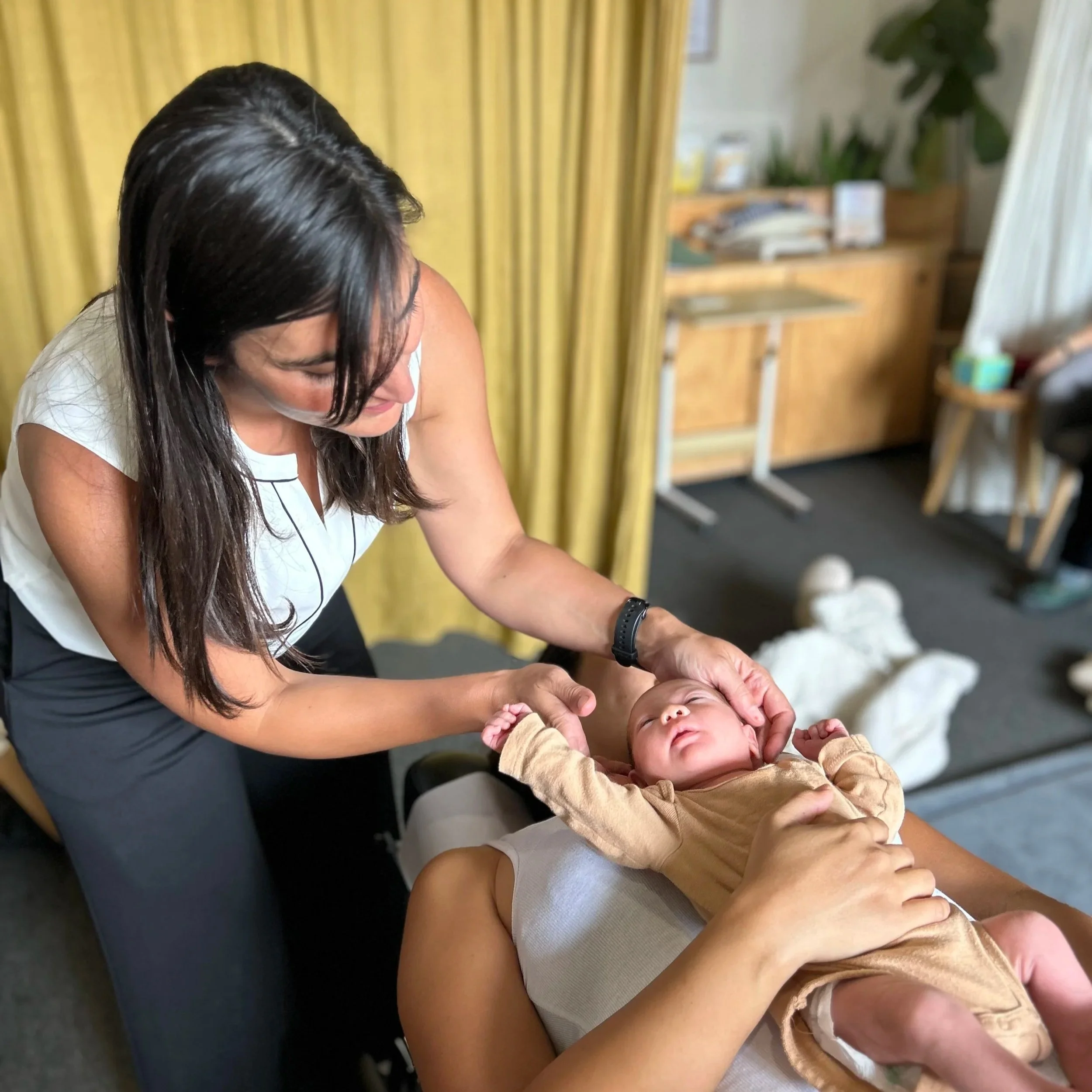
Why Would You Take a Baby to a Chiropractor?
It’s a fair question.
And honestly — one we want parents to ask.
Because when most people hear “chiropractor,” they think of adults with back pain. They don’t think about:
Feeding difficulties
Digestive discomfort
Unsettled sleep
Body tension
Tongue function
Nervous system regulation
Developmental support
But at Nomad Chiropractic, this is exactly what we focus on.
As parents ourselves, we understand how vulnerable those early weeks can feel. You’re exhausted, learning your baby in real time, and constantly wondering:
“Is this normal… or is something not quite right?”
Sometimes babies simply need time to adapt.
Sometimes they need support.
And sometimes, gentle chiropractic care can completely change the experience of early parenthood.
🌼 Learn more here
Birth Is Powerful — But It’s Also Physically Demanding
Even the smoothest, most physiological birth places significant physical stress on a baby’s body.
During labour and delivery, babies experience:
Compression through the pelvis
Rotational forces through the neck and spine
Pressure through the cranial bones
Tension through the jaw and diaphragm
Sudden adaptation to gravity and stimulation
When birth becomes more medically complex — including:
Long labour
Very fast labour
Forceps or vacuum delivery
Caesarean birth
Induction
Breech positioning
…the physical load on a baby’s nervous system and body can increase further.
This doesn’t mean something has “gone wrong.”
But it does mean babies can develop tension patterns that affect how they feed, digest, sleep, and regulate.
🌼 Learn more here
Pregnancy Care Matters More Than Most People Realise
One of the biggest things we’ve learnt clinically is this:
Babies often start benefiting from chiropractic care before they’re even born.
Our Pregnancy Chiropractic Care page explains how supporting the mother’s pelvis, posture, nervous system, and movement patterns during pregnancy may help reduce physical stress on both mum and baby.
When the pelvis moves well and the nervous system is more regulated:
Babies often have more room to move
In-utero constraint may reduce
Maternal discomfort decreases
Birth preparation improves
Feeding and postpartum recovery may become easier
Many parents tell us:
“I wish I’d started care earlier in pregnancy.”
🌼 Learn more here
Why We Use the Webster Technique During Pregnancy
At Nomad Chiropractic, we commonly utilise the Webster Technique as part of pregnancy care.
The Webster Technique is a gentle chiropractic analysis and adjustment approach designed to reduce tension and imbalance in the pelvis and surrounding soft tissues during pregnancy.
Importantly:
It is not a technique to “turn babies”
It does not force fetal positioning
It focuses on improving pelvic balance and nervous system function.
Why does this matter?Because when pelvic tension is reduced, babies may have greater ability to:
Move freely in utero
Position themselves optimally for birth
Experience less mechanical constraint during labour
This often creates a calmer transition into the postpartum period for both mother and baby.
🌼 Learn more here
Babies Don’t Need to Have a “Problem” to Benefit From Care
One of the biggest misconceptions about infant chiropractic care is that babies only see us when something is wrong.
At Nomad, many families bring their babies in simply because they want to:
Support nervous system development
Encourage better feeding and digestion
Reduce tension patterns early
Improve sleep and regulation
Optimise movement and milestones
Create healthier long-term foundations
We view baby chiropractic as proactive nervous system support during one of the most critical developmental windows of life.
The Nervous System Controls Everything
Your baby’s nervous system influences:
When babies experience stress, overload, or physical tension, their body often communicates through behaviour.
This may look like:
These are not always “medical problems.”
But they can be signs that a baby’s nervous system is under stress.
Tongue Tie, Feeding Difficulties & Why We Co-Manage Care
One of the most common reasons babies are referred to us is for feeding challenges — especially when families are navigating concerns around tongue ties, latch dysfunction, reflux, or poor weight gain.
At Nomad Chiropractic, we never see feeding as “just a tongue issue.”
Feeding is a complex neurological and biomechanical process involving:
Tongue function
Jaw mechanics
Cranial nerves
Neck mobility
Diaphragm movement
Postural tone
Reflex integration
Nervous system regulation
This is why we frequently work alongside:
IBCLC lactation consultants
Paediatric dentists
Tongue tie release providers
GPs
ENTs
Osteopaths
Maternal health practitioners
Sometimes babies present with:
Clicking while feeding
One-sided latch preference
Poor tongue mobility
Neck tightness
Arching or discomfort during feeds
Excessive wind or reflux
Difficulty opening wide
And importantly → Not every feeding issue is caused by a tongue tie.
Sometimes the primary issue is body tension, cranial restriction, birth strain, or nervous system overload.
At the same time, true tongue ties — particularly posterior ties — are frequently missed or underestimated.
This is why collaborative care matters so much.
Before and after tongue tie release procedures, chiropractic care may help:
Reduce body tension
Improve jaw and neck mobility
Support cranial function
Improve postural stability
Help babies integrate new tongue movement patterns
Regulate the nervous system during feeding
Our role is not to diagnose tongue ties… but to support you and your baby through it.
Our role is to help babies function more comfortably while supporting families through a collaborative care approach.
You can explore more on our dedicated:
👉 Tongue Tie & Feeding Support page
Because successful feeding support is rarely about one practitioner.
It’s about building the right team around both baby and parents.
What Actually Happens During a Baby Chiropractic Appointment?
This is usually where parents breathe a sigh of relief.
Because no — we do not crack babies.
Infant chiropractic care is incredibly gentle and specific.
At Nomad, sessions often include:
Cranial work
Sustained light contact
Gentle spinal balancing
Reflex assessment
Nervous system regulation
Soft tissue release
The pressure used is extremely light — often compared to checking the ripeness of a tomato.
Most babies:
Sleep during care
Feed during care
Relax during adjustments
Become calmer and softer in their body over time
Our appointments are always baby-led and adapted to your child’s needs.
🌼 Learn more here
Feeding, Digestion & Sleep Are Deeply Connected
One of the most common things parents notice after care is improvement in:
Feeding
Digestion
Sleep
And that’s because all three are heavily influenced by the nervous system.
The vagus nerve — one of the body’s major parasympathetic nerves — plays a huge role in:
Digestive function
Swallowing
Calm regulation
Sleep states
Feeding coordination
Birth tension around the upper neck, jaw, diaphragm, or cranial base may affect how efficiently this system functions.
Gentle chiropractic care aims to reduce tension and improve nervous system communication so babies can:
Feed more effectively
Digest more comfortably
Sleep more deeply
Settle more easily
🌼 Learn more here
You can also explore our blogs on:
Postpartum Care Matters Too
Something we’re deeply passionate about at Nomad is supporting the mother after birth — not just the baby.
The postpartum period places enormous stress on:
The nervous system
Feeding posture
Sleep patterns
Pelvic recovery
Our Postpartum Chiropractic Care page explains how caring for the mother’s nervous system often positively impacts the baby too.
Because babies regulate through connection.
And supported mothers regulate more easily.
🌼 Learn more here
Chiropractic Care for Babies Is Safe
Research consistently shows that chiropractic care for infants — when delivered by trained practitioners using appropriate techniques — is extremely safe.
At Nomad:
We complete full assessments
We screen for red flags
We collaborate with medical and allied health providers
We refer when necessary
We stay within scope
We’re not here to replace medical care.
We’re here to complement it with gentle nervous system support.
🌼 Learn more here
The Nomad Difference for Family Chiropractic Care
At Nomad Chiropractic, our approach is:
Neurologically focused
Cranially informed
Reflex-aware
Family-centred
Evidence-informed
Gentle and baby-led
We blend:
Sacro Occipital Technique (SOT)
Cranial techniques
Primitive reflex understanding
Nervous system regulation
Developmental support
But perhaps most importantly:
We listen.
We listen to:
Your concerns
Your instincts
Your observations
Your birth story
Your goals as parents
Because often parents know something is “off” long before anyone else validates it.
Learn more about how we work:
Frequently Asked Questions about our Chiropractic Care for Babies
1. Should babies be checked after a caesarean birth too?
Yes. While caesarean births avoid the compression of the vaginal canal, babies can still experience significant physical stress before and during surgery — especially if labour was long, induced, or involved positioning challenges. Many babies born via C-section still present with neck tension, feeding difficulties, reflux, or body asymmetry.
2. Can chiropractic care help babies who hate tummy time?
Sometimes, yes. Babies who struggle with tummy time may be experiencing neck tension, cranial discomfort, shoulder restriction, or difficulty activating postural muscles comfortably. Gentle chiropractic care may help improve comfort, movement, and body awareness, making tummy time feel less stressful and more achievable.
3. Does my baby need chiropractic care if they seem “mostly fine”?
Not necessarily — but many parents choose care proactively to support healthy nervous system development, movement patterns, and adaptation after birth. Just like adults often function better when their body moves well, babies may also benefit from early support even without major symptoms.
4. How soon after birth can a baby see a chiropractor?
Babies can be checked within days of birth if parents choose. Many families bring babies in during the first few weeks, especially after difficult births, feeding challenges, tongue tie concerns, or unsettled behaviour. Care is always gentle, age-appropriate, and adapted to the baby’s stage of development.
5. Why does chiropractic care often involve cranial work for babies?
A baby’s cranial bones are not fully fused at birth and undergo significant moulding during labour and delivery. Gentle cranial techniques may help reduce tension around the skull, jaw, upper neck, and cranial nerves — areas closely connected to feeding, digestion, sleep, and nervous system regulation.
-
⚠️ Disclaimer:
This information is educational only and is not intended to replace individual medical advice. Chiropractors do not claim to “treat” medical conditions in infants. If you have concerns about your baby’s health or development, please consult your GP, paediatrician, or other qualified health professional. -
Carnes, D., Plunkett, A., Ellwood, J., & Miller, J. E. (2010). Manual therapy for unsettled infants: A systematic review. BMC Pediatrics, 10, 26.
Miller, J. E., & Newell, D. (2012). Safety of chiropractic manual therapy in children. Chiropractic & Manual Therapies, 20(15).
Olafsdottir, E., et al. (2001). Randomised controlled trial of chiropractic treatment for infantile colic. Archives of Disease in Childhood, 84(2), 138–141.
Todd, A. J., et al. (2021). Adverse events due to chiropractic and other manual therapies in children. BMJ Open, 11(2).
Wiberg, J. M., et al. (2011). Manual therapy and infantile colic. Chiropractic & Manual Therapies, 19(3).
Want to learn more? Book a FREE 15min discovery call with one of our Sydney Pregnancy, Postpartum & Paediatric Chiropractors today: Book HERE
Gentle, Evidence-Informed Chiropractic Care for Babies in Mosman
At Nomad Chiropractic, we believe infant chiropractic care is about supporting healthy nervous system development during one of the most important periods of life. Our gentle, baby-led approach focuses on reducing tension patterns that may impact feeding, digestion, sleep, tongue function, posture, and emotional regulation.
We work collaboratively with IBCLC lactation consultants, paediatric dentists, GPs, ENTs, and maternal health providers to support families navigating feeding difficulties, tongue ties, birth tension, reflux, and unsettled babies.
Through pregnancy care, the Webster Technique, postpartum support, and infant chiropractic care, our goal is to help babies adapt, regulate, and thrive naturally — while supporting parents every step of the way.