
Why Is My Baby Rocking on Hands and Knees? The Stage Before Crawling
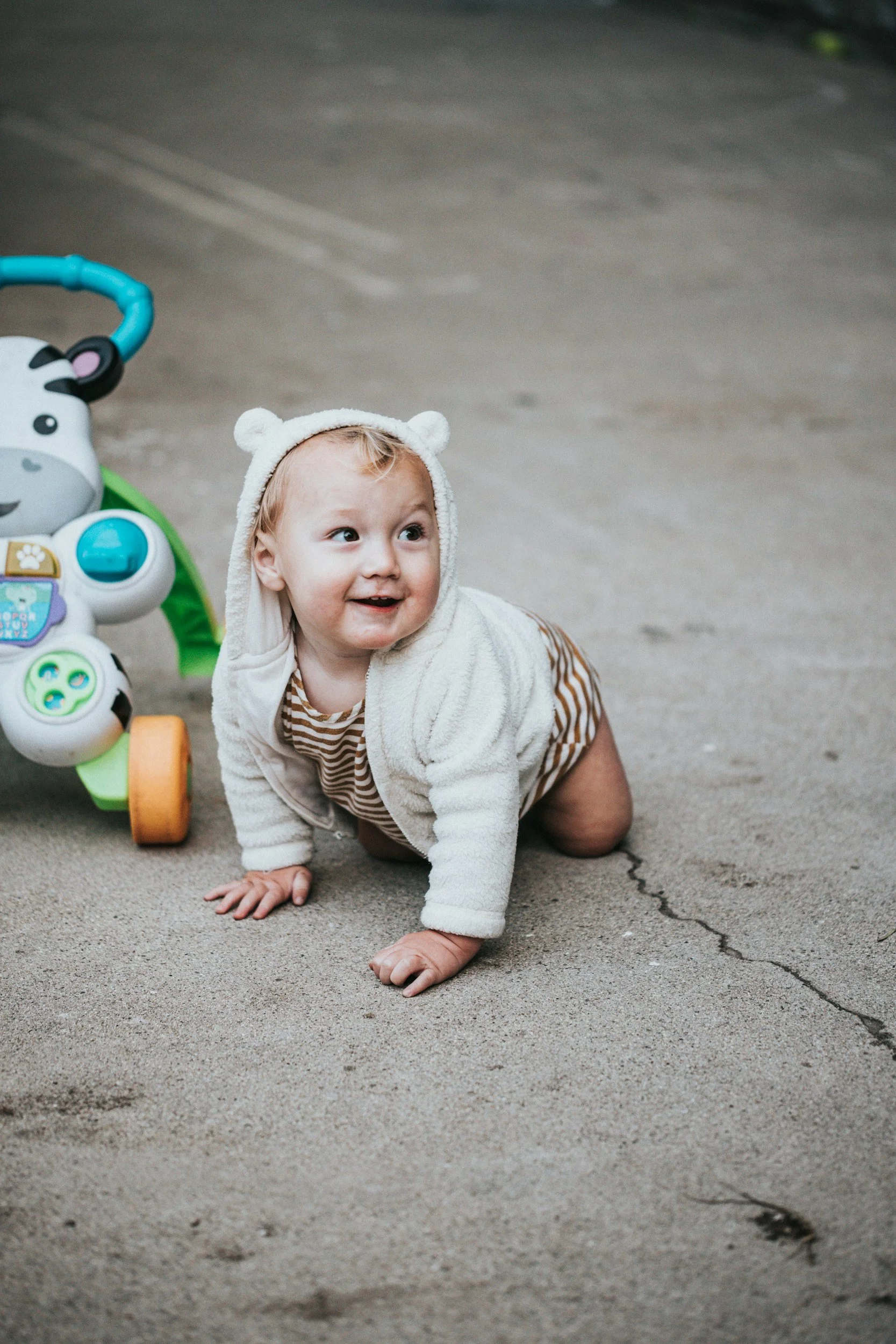
You put your baby down on the floor and suddenly they’re up on all fours - hands planted, knees underneath them - rocking backwards and forwards like they’re about to launch themselves across the room.
But they don’t actually go anywhere!
If your baby has started rocking on their hands and knees, you may be wondering: Does this mean crawling is coming? Is the rocking normal? How long do babies do this before crawling? And should I be encouraging it?
The short answer is: rocking on hands and knees is a common developmental stage as babies explore the position used for crawling.
It gives your baby an opportunity to practise supporting their body on four points, shifting their weight, coordinating their arms and legs and figuring out how to maintain balance before adding forward movement.
Some babies rock for days or weeks before crawling. Some move backwards first. Some transition between sitting, kneeling and all fours repeatedly. And some babies never spend much time rocking at all.
There is plenty of normal variation.
Here’s what is actually happening when your baby starts rocking on all fours - and some simple ways you can support the next stage of movement.
What Does It Mean When a Baby Rocks on Hands and Knees?
Rocking usually happens when a baby has discovered the quadruped position - weight-bearing through both hands and both knees. Getting into this position is already quite an achievement. Your baby needs enough shoulder and arm strength to support their upper body, trunk control to stop their tummy collapsing towards the floor, hip control to keep their knees underneath them, and balance to remain stable while their centre of gravity changes. → Then comes the rocking.
→ Your baby shifts their body forwards towards their hands and backwards towards their knees.
It may look repetitive, but they are experimenting with an entirely new relationship between their body and gravity.
Eventually, they begin to discover something important: they can take one hand or knee off the floor without falling over.
That is where rocking can start to become crawling!
What Age Do Babies Start Rocking on Hands and Knees?
There isn't one exact age when babies should begin rocking.
Many parents notice it during the second half of the first year, often around the period when babies are becoming more independent in sitting, pivoting on their tummy, moving between positions and preparing to crawl.
Development isn't a rigid timetable.
So rather than becoming fixated on an exact month, look at your baby's overall movement progression.
Are they gaining new skills?
Are they exploring?
Are they becoming stronger?
Are they using both sides of their body?
Are their movements gradually becoming more varied and controlled?
→ The quality and progression of movement can tell us more than a birthday on the calendar.
For babies born prematurely, development is also generally considered using corrected age rather than simply chronological age.
Does Rocking on All Fours Mean My Baby Will Crawl Soon?
Often - but not necessarily tomorrow.
Rocking can be one of the movements babies practise before hands-and-knees crawling.
Initially your baby may simply hold the position.
Then they might start rocking.
Then they may shift their weight towards one hand to reach for a toy.
They might push themselves backwards instead of forwards.
They may move one knee and collapse.
They might crawl two steps and sit back down.
Then one day, everything seems to click.
The American Academy of Pediatrics describes babies spending time rocking on their hands and knees before crawling, and notes that babies may initially push themselves backwards because their arms can be stronger than their legs.
So if your baby looks ready to crawl but keeps reversing across the room, don't panic.
They are still learning how force, balance and movement work.
Why Rocking on Hands and Knees Matters
Rocking isn't an official developmental milestone that every baby must demonstrate.
But the position itself provides a wonderful movement challenge.
1. It Builds Shoulder and Arm Strength
Unlike sitting, being on all fours requires your baby to support part of their body weight through their hands, wrists, elbows and shoulders.
That upper-body strength becomes useful for crawling, climbing, pushing themselves up from the floor and exploring increasingly complex movement.
It also gives babies a very different sensory experience through their hands.
2. It Challenges Core and Trunk Control
Your baby's trunk has to remain controlled while their body moves backwards and forwards.
That is harder than simply holding a static position.
Eventually your baby needs enough trunk control to shift weight towards one side while lifting the opposite hand or knee.
This ability to stabilise one part of the body while another part moves is important for increasingly complex motor skills.
3. It Teaches Weight Shifting
Crawling requires something sitting doesn't: controlled instability.
To move one hand forwards, your baby temporarily needs to support themselves through the other hand and their knees.
To move a knee, their weight needs to redistribute again.
Rocking lets babies practise shifting their centre of gravity forwards and backwards while keeping four points of contact with the floor.
As their control improves, those weight shifts can become more diagonal and dynamic.
4. It Develops Body Awareness
Your baby's brain is constantly receiving information from their joints, muscles, skin, eyes and vestibular system about where their body is in space.
Being on hands and knees creates lots of this sensory information.
How much pressure is going through my hands?
Where are my knees?
What happens when I lean forwards?
How far backwards can I go before I sit down?
What happens if I lift one hand?
Babies learn movement by moving. They experiment, wobble, adjust and repeat.
5. It Creates an Opportunity for Left-Right Coordination
Once rocking progresses into crawling, the movement can become reciprocal: one arm advances while the opposite leg advances.
But before babies can coordinate that pattern, they first need to become comfortable supporting themselves on all fours and shifting their weight.
This is why the period before crawling can look surprisingly repetitive. Your baby isn't wasting time. They're practising.
And is associated with primitive reflex integration: prefrontal cortex taking over from the survival brain, learning through skeletal muscle activation, strength and coordination… it’s developmentally amazing.
Why Does My Baby Rock but Not Crawl?
This is incredibly common.
Your baby may simply not have figured out how to turn a stable four-point position into forward movement yet. Think about the problem they're trying to solve. To crawl, they have to intentionally make themselves less stable. They need to transfer enough weight away from one limb to lift it, move it and put it down somewhere else - without the rest of their body collapsing. Then they have to repeat that sequence with another limb. That's complicated!
So your baby may happily rock for a while before attempting it.
You might also notice them:
rocking very enthusiastically
lifting one hand and putting it back down
reaching for toys from all fours
moving backwards
dropping onto their tummy
moving from all fours back into sitting
kneeling against furniture
doing a few crawling movements and stopping
These can all be part of exploration around this stage.
Why Is My Baby Crawling Backwards?
Backward movement before forward crawling is another classic parent question.
And yes - it can look hilarious when the toy your baby desperately wants gets progressively further away.
Early on, babies may generate more effective force through their arms than through their legs. Instead of propelling themselves forwards, they push through their hands and accidentally move backwards. The American Academy of Pediatrics specifically describes this as something that may occur while babies are learning to crawl. Give them time. They are working it out.
How to Encourage Rocking and Crawling at Home
You don't need specialised developmental equipment. → For most babies, the best playground is simply the floor.
For some simple home exercises that might assist your baby’s development click here
1. Give Them Plenty of Floor Time
Movement requires opportunity.
Give your baby regular supervised time on a firm, safe floor where they can roll, pivot, sit, reach, kneel and experiment with getting onto all fours.
A baby has much more opportunity to practise movement on the floor than when spending long periods restrained in seats, swings or other containers.
2. Put Toys Slightly Out of Reach
Not frustratingly far away. Just far enough that your baby needs to problem-solve.
Try placing a favourite toy slightly in front and to one side while they're on all fours. They may transfer their weight onto one hand and reach with the other. That little weight shift is useful practice.
→ Change sides so they have opportunities to reach with both hands.
3. Create a Small Obstacle
Once your baby is comfortable on the floor, a rolled towel, your leg or a low cushion can make movement more interesting.
Encourage them to move over, rather than simply towards, something. Keep it low and supervise closely. The aim isn't to make an infant obstacle course worthy of the Olympics. It's simply to give their body a slightly different movement problem to solve.
4. Let Them Practise Transitions
Development isn't only about holding positions. It is also about getting into and out of them.
Watch what your baby does between:
tummy → all fours
all fours → sitting
sitting → side sitting
all fours → kneeling
kneeling → standing
Those transitions can be just as interesting as the milestone itself.
Rather than constantly placing your baby into the position you want, give them opportunities to work out how to get there themselves.
5. Use Your Body as the Equipment
Sit on the floor with your baby.
Let them climb over your leg.
Place a toy on the opposite side of you.
Get down on your own hands and knees.
Crawl towards them.
Babies learn through interaction and imitation, and you are considerably more interesting than most developmental toys.
What Should I Watch For When My Baby Is Rocking?
Don't analyse every wobble.
Early movement is supposed to be messy.
But over time, we like to see variety, progression and reasonably symmetrical use of the body.
Watch how your baby moves rather than focusing only on whether they can tick off a milestone.
Things you might notice include:
Using both hands
Does your baby comfortably bear weight through either hand?
Can they reach with the right and the left?
Using both legs
Are both knees participating when they start moving?
Turning both ways
Can your baby rotate and transition towards either side?
Progression
Is their movement changing over time?
Rocking may become reaching. Reaching may become a few crawling movements. Crawling may become faster and more coordinated.
Development doesn't have to be perfectly linear, but we generally want to see new options emerging.
What About Asymmetrical Crawling?
Babies don't emerge from the womb with textbook-perfect crawling technique. Some asymmetry while learning can happen… but persistent asymmetry should be checked
eg. Is there a strong and persistent preference?
For example:
consistently dragging the same leg
always keeping one leg straight
refusing to bear weight through one arm
repeatedly collapsing towards the same side
only transitioning through one side
persistent one-sided movement
a clear difference in strength or movement between sides
If you repeatedly notice something that doesn't look balanced, it is reasonable to have your baby's movement assessed.
It can indicate weakness, restriction, and/or primitive reflexes not integrating effectively etc… That’s where we can step in! And are likely to be able to help.
What If My Baby Never Rocks on Hands and Knees?
Not every baby follows exactly the same developmental sequence. And importantly, rocking itself is not a mandatory milestone, whilst it does serve a purpose. Some babies spend weeks doing it. Others seem to discover all fours and crawling almost simultaneously.
If you’re unsure - no harm in checking in with your paediatric chiro.
When Should I Seek Help About My Baby's Movement?
If something about your baby's movement doesn't look right to you, you don't need to wait until they have officially “missed” a milestone to ask.
Consider a chiro check if you notice:
loss of a skill your baby previously had
a difference between the two sides of the body
persistent stiffness or unusual floppiness
difficulty bearing weight through an arm or leg
consistently using one side while avoiding the other
limited movement variety
difficulty progressing through several motor skills
persistent head or body preference
pain or obvious distress with movement
or simply a developmental pattern that concerns you → your gut feeling something isnt right.
How We Look at Baby Development at Nomad Chiropractic
At Nomad Chiropractic in Mosman, we see babies from Mosman, Neutral Bay, Cremorne, North Sydney ~ across Sydney's Lower North Shore and Northern Beaches ~ for a range of reasons. That includes parents wanting another set of eyes on their baby's movement and physical development.
When assessing a baby, we aren't interested only in whether they have technically “achieved” crawling.
We look at how they move.
During developmental assessments we may observe:
head control
spinal joint motion
shoulder/elbow/wrist motion
ankle/knee/hip motion
cranial motion
symmetry
movement quality
Paediatric Chiropractic care aims to support healthy nervous system function
That may include observing:
rolling
sitting
transitions
weight-bearing
all-fours positioning
Our approach to babies is gentle and age-appropriate.
We also spend plenty of time educating parents about practical activities they can confidently do at home to encourage movement and development.
No single therapy replaces active play - and movement remains one of the greatest gifts you can give a developing brain.
The Bigger Picture
If your baby has just started bouncing backwards and forwards on their hands and knees, enjoy it. And equally if they’re up on all 4s you can teach them to rock → hold onto their hips whilst theyre up on all 4s and gently rock them back and forth! Have a giggle - have fun with it.
They've discovered something new. They may crawl next week. They may spend several weeks enthusiastically rocking, reversing and face-planting into the play mat before they work it out. There is no prize for getting across the room first.
→ Give them safe floor time, interesting things to explore and plenty of opportunities to practise movement independently.
Because before babies become efficient crawlers, they often spend a lot of time doing something that looks like they're going nowhere.
They aren't going nowhere. They're learning how to move.
A Note on the WHO’s report on Importance of Crawling from our founder:
Dr Lucy Bartlett | Chiropractor, ACCP, DACCP, MChiro, BChiroSc, BBus.
“I categorically disagree with the suggestion that skipping crawling should be considered developmentally insignificant simply because a percentage of healthy babies do so.
Just because something is observed within a population does not mean it is developmentally optimal. Common does not automatically mean ideal.
In my educated clinical opinion, hands-and-knees crawling is a fundamental stage of neurological development. It provides important opportunities for cross-patterned movement, bilateral coordination, sensory integration, postural control and the development of connections between the brain and body.
Babies aren't simply learning to move from A to B. They are developing and refining the neural pathways that underpin increasingly complex movement and coordination.
The fact that a child can skip crawling and still learn to walk does not establish that crawling was unnecessary.
My concern with this interpretation of the WHO findings is that achieving independent walking is not the same as evaluating long-term neurological and developmental outcomes. Were these children reassessed at school age? Were their coordination, balance, motor planning, sensory processing and primitive reflex profiles evaluated years later?
These are important questions, particularly when considering the potential persistence of primitive reflexes and their possible associations with later motor coordination and developmental challenges. The absence of an obvious problem in infancy does not necessarily establish the absence of subtle difficulties later in childhood.
We cannot assume that because a child walks on time, every aspect of their neurological development has progressed optimally.
I firmly believe we should be protecting, encouraging and prioritising this developmental stage, rather than minimising its importance because some children appear to progress perfectly well without it.”
Dr Lucy Bartlett (Chiropractor)
Nomad Chiropractic
Learn more about how we work:
FAQs: Baby Rocking on Hands and Knees
1. Why is my baby rocking back and forth on hands and knees?
Rocking on hands and knees is a common movement babies may practise while learning to crawl. It allows them to experience weight-bearing through their hands and knees while practising balance, trunk control and shifting their body weight forwards and backwards and is associated with wiring of the prefrontal cortex and primitive reflex integration. It generally occurs before crawling.
2. How long after rocking on hands and knees do babies crawl?
There is no set timeframe. Some babies may begin crawling relatively soon after discovering all fours, while others practise rocking, reaching, moving backwards and transitioning between sitting and all fours for considerably longer. A broad normal range to start crawling would be approx 5-8mths. Learn more about crawling here
3. What age do babies get on hands and knees?
Many babies begin exploring all fours during the second half of their first year, but there is considerable normal variation. Rather than expecting the skill at an exact age, look for overall progression in floor movement, sitting, transitions, weight-bearing and exploration. Corrected age should be considered for babies born prematurely.
4. Why does my baby rock on all fours but move backwards instead of crawling forwards?
Moving backwards can happen while a baby is learning how to coordinate crawling. Babies may initially generate more force through their arms, causing them to push themselves backwards. With floor time and practice, many babies gradually work out how to coordinate their arms and legs to move forwards.
5. Should I be worried if my baby isn't rocking or crawling?
Not necessarily. Rocking on all fours isn't a milestone every baby must demonstrate, and some healthy babies use alternative ways of moving or skip traditional hands-and-knees crawling. Seek individual advice if your baby loses previously acquired skills, shows persistent asymmetry, doesn't use one arm or leg normally, appears unusually stiff or floppy, experiences pain with movement, or you have concerns about their overall developmental progress.
-
⚠️ Disclaimer:
This information is educational only and is not intended to replace individual medical advice. Chiropractors do not claim to “treat” medical conditions in infants. If you have concerns about your baby’s health or development, please consult your GP, paediatrician, or other qualified health professional. -
World Health Organization Multicentre Growth Reference Study Group. (2006). WHO Motor Development Study: Windows of achievement for six gross motor development milestones. Acta Paediatrica Supplement, 450, 86–95.
World Health Organization. Child Growth Standards: Motor Development Milestones. WHO.
World Health Organization Multicentre Growth Reference Study Group. Assessment of gross motor development in the WHO Multicentre Growth Reference Study.
American Academy of Pediatrics. Movement: 8 to 12 Months. HealthyChildren.org.
American Academy of Pediatrics. Crawling Styles. HealthyChildren.org.
American Academy of Pediatrics. Developmental Milestones: 12 Months. HealthyChildren.org.
Centers for Disease Control and Prevention. Milestones by 9 Months: Learn the Signs. Act Early.
Adolph, K. E., & Franchak, J. M. (2017). The development of motor behavior. Wiley Interdisciplinary Reviews: Cognitive Science, 8(1–2), e1430.
Hadders-Algra, M. (2018). Early human motor development: From variation to the ability to vary and adapt. Neuroscience & Biobehavioral Reviews, 90, 411–427.
Iverson, J. M. (2010). Developing language in a developing body: The relationship between motor development and language development. Journal of Child Language, 37(2), 229–261.
If you're concerned about your baby's movements, we'd love to assess them! Get in touch.
Want to learn more? Book a FREE 15min discovery call with one of our Mosman, Baby Chiropractors today: Book HERE
Gentle, Evidence-Informed Chiropractic Care for Babies in Mosman
Baby Rocking on Hands and Knees - Rocking on all fours is a natural stage before crawling, helping babies develop strength, balance, coordination and weight shifting. At Nomad Chiropractic in Mosman, our paediatric-trained chiropractors understand the subtleties of infant movement and development. Curious about your baby's progress? We'd love to help you explore their next milestones. Discover our baby chiropractic care.